WHY THE ANGLED TAKE OFF IS VERY IMPORTANT FOR LONGBOARDING
Up until this point you’ve likely been catching waves and getting to your feet with your board pointing directly to the beach.
This is fine for catching whitewater waves, but when it comes to green waves it’s not always the best option for a number of reasons (more on that in a minute).
So in this lesson you’re going to learn all about the angled take off, how to do it, why it’s important, and everything in between.
WHAT IS AN ANGLED TAKE OFF?
As the name suggests, an angled take off is a method for taking off on a green wave where your surfboard is already pointing in the direction that you want to go to help you set your line across the wave quicker.
HOW MUCH OF AN ANGLE SHOULD I USE?
Too much of an angle and you’ll catch your outside rail and fall off, too little of an angle and you won’t make it around the section in front of you.
That’s why we recommend an angle of no more than 45 degrees to begin with.
Yes, this angle will vary depending on the wave that’s coming to you, but this is a good guide to get you started.
WHY USE THE ANGLED TAKE OFF IN THE FIRST PLACE?
The angled take off is a technique that will help you in a number of ways, I’ll break them down in a little more detail below:
HELPS TO GET AROUND SECTIONS
Taking off on an angle sets your line across the wave from the moment you pop to your feet, helping you to start moving across the wave quicker and make it around bigger sections to spend more time surfing the green unbroken part of the wave.
REDUCES THE STEEPNESS OF THE TAKE OFF
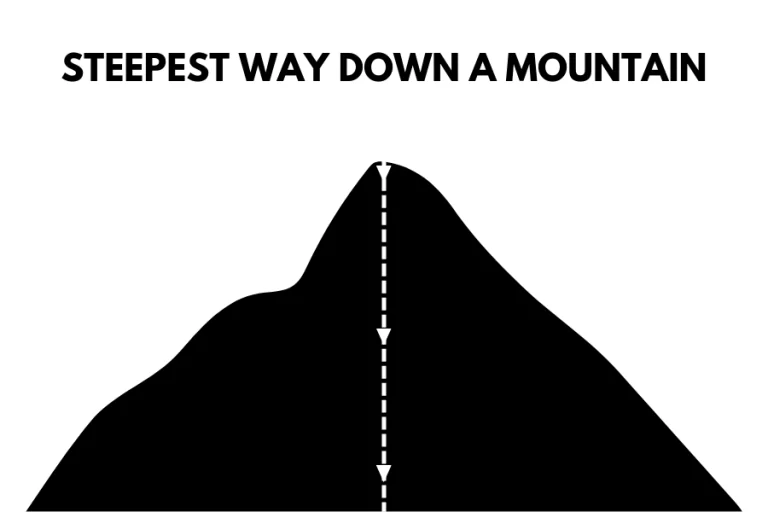
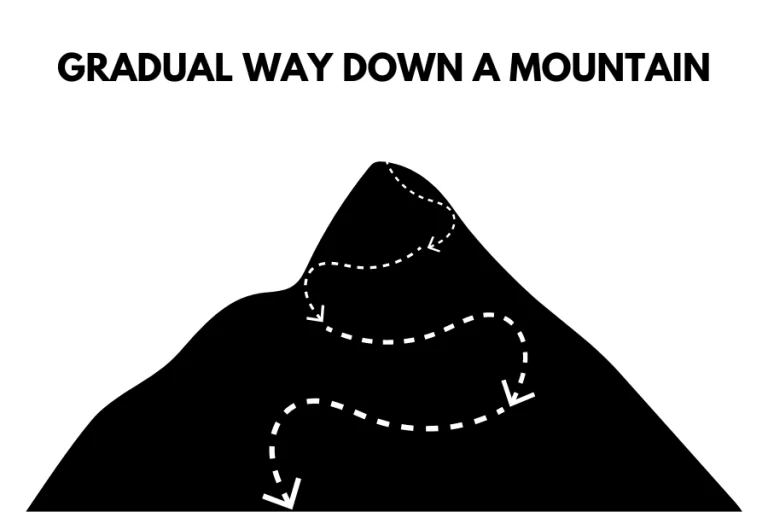
Quick thought experiment for you…
If you were to walk up a steep mountain would it be easier to:
a) Just go up in a straight line.
b) Go in zig-zags up and around.
If you hadn’t guessed already the answer’s b.
Why?
As you go from side to side you take off the severity of the incline making the assent easier.
We can achieve the same result with an angled take off too, reducing the severity of the steep wave by going across it rather than straight down.
INCREASED SUCCESS RATE
Now that you’re reducing the severity and the steepness of the wave you’ll see your success rate in making steep drops increase.
SAFETY
Whats more, with this as a technique in your arsenal your chances of nosediving will reduce massively and you’ll be able to navigate steeper drops more safely as a result.
HOW IT’S DONE
- Choose which way you are going to go on the wave – left or right.
- When you see the wave approaching, paddle into the best position for your take off.
- Get your board speed up by paddling perpendicular to the beach.
- In the last 3 strokes start to angle your board in the direction you want to go.
- Use the nose of the board as your guide and begin to mentally draw your line down the wave.
- As you prepare to pop up look in the direction of where you want to go (don’t forget to always have a quick look back to see that you’re not dropping in on anyone).
- Place both hands on the deck and open both your shoulders.
PRO TIP: Sometimes your outside hand is a little further up the board than your inside hand when popping up, can also be helpful to slightly rotate shoulders and hips.
- Apply more pressure to your inside rail to help angle your board and grip the rail into the wave face.
- As you lift your chest up, bring your legs through. Place your back leg first on the tail pad and follow through with your front foot.
- Back foot 90-degree and front foot 45-degree angle on the deck of your board.
- Keep your knees very slightly bent and arms close to your body.
- Surf in the middle of the wave face. Draw an imaginary line that goes down the middle of the wave.
COMMON MISTAKES
- ANGLED TO MUCH: If you paddle on too much on a severe angle, you are going to either not catch the wave and come off the shoulder, or catch the wave and snag your outside rail and wipeout.
- ANGLED TO LITTLE: Not enough angle and you’ll have to navigate an unnecessarily steep drop and get caught behind the section.
- ANGLED TOO EARLY: If you’re paddling at an angle too early you won’t have enough forward momentum to catch the wave, so try and save the angling for the last few paddle strokes if you can.
- TOO MUCH WEIGHT ON YOUR INSIDE RAIL: There is a tendency with this technique to put too much weight onto your inside rail as you’re popping up. The result is that you’ll pop to your feet and the wave will just pass underneath you. There’s a sweet spot with your weight distribution that you’ll have to find for yourself, but with practice this becomes second nature.
WRAPPING IT UP
The angled take off is a technique that’ll help you successfully ride out of more waves more often, attack steeper drops with more success, and help you to make it around bigger sections.
All in all it’s a super important skill to learn, one that’ll pay you back ten-fold once you’ve got it dialled.
So keep practicing it each time you’re out in the water, challenge yourself to take off on steeper waves than you’d usually take and keep plugging away at it until the movements begin to become second nature.
Why not even try doing it at home too?
Even just popping up on the living room floor and mind-surfing will begin to program the muscles with the movements ready for when it’s time to hit the water.